
Listen to case study
My role and scope
Role: Founding Principle Designer (2018–present).
Scope: As the founder, I led the full product and experience vision for Bespeak, guiding the platform from early concept through research, strategy, systems mapping, and prototyping. My work spanned community listening, user research, service design, information architecture, interaction design, high-fidelity prototyping, and early roadmap creation.
I collaborated with residents, property managers, and civic partners to translate local needs into a unified engagement model. I created the platform’s design system, brand identity, accessibility standards, and interaction patterns, ensuring that Bespeak could scale across neighborhoods, municipalities, and civic organizations. I also shaped the long-term product strategy, business model, and copyright framework to prepare the platform for government adoption and sustainable growth.
Challenge
Cities often struggle to engage residents in meaningful dialogue about development, zoning, neighborhood projects, and policy-level decisions.
Most platforms rely on static surveys, fragmented communication, or siloed committees, which leaves entire communities — especially historically underrepresented neighborhoods — without a real voice in shaping the places they live. Pittsburgh Yards and surrounding communities in Southwest Atlanta surfaced a recurring problem:
Community partners wanted deeper engagement, faster feedback loops, and tools that translated conversations into action. Residents wanted transparency, collaboration, and trust.
The opportunity was clear:
Create a system where every voice can shape the future, not just respond to it.
Constraints
With community-scale problems came very real constraints:
-
Limited budgets and lean staffing across local organizations and property developments.
-
Low digital literacy among some residents, requiring an intuitive, low-friction experience.
-
Fragmented engagement channels — social media, email lists, neighborhood meetings, and third-party tools — none of which created a unified ecosystem.
-
High mistrust of digital tools that traditionally only gather data without returning value to the community.
-
Need for continuity across multiple neighborhoods, not just one development or one council.
These constraints shaped every design decision. Bespeak couldn’t just be a product. It had to be a community infrastructure system.
Process
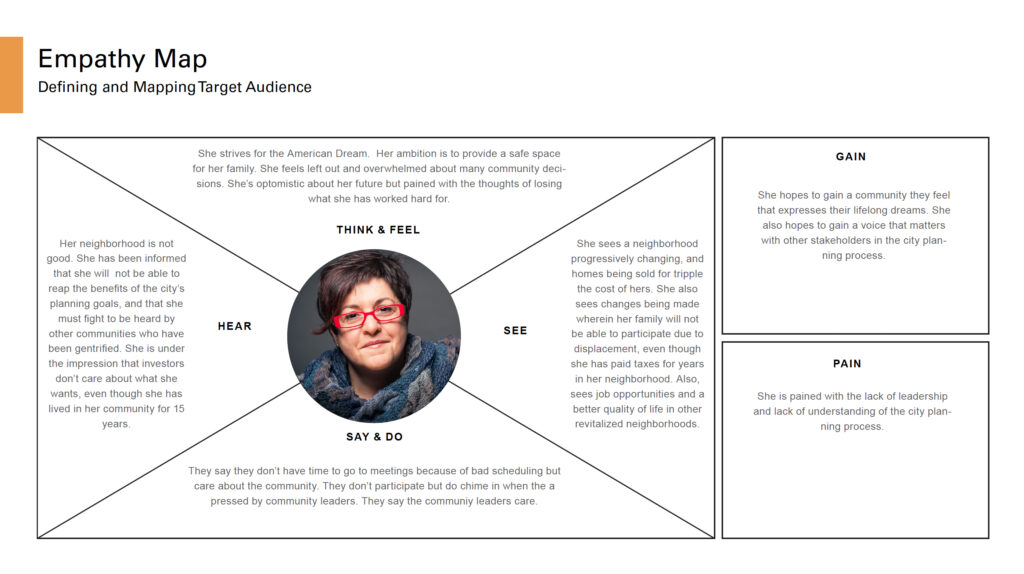
To ground Bespeak in real community needs, I began by listening to residents, youth leaders, nonprofits, and property managers to understand why existing engagement tools failed.
Trust was low, workflows were fragmented, and no shared space existed for ideas or decision tracking. From this research, I defined three experience pillars: accessibility, transparency, and collective intelligence. I then mapped the full civic ecosystem through a multi-layered service blueprint, detailing resident touchpoints, administrator workflows, data flows, and decision lifecycles. This systems view revealed friction points and opportunities for AI augmentation, allowing me to architect Bespeak as a unified community engagement platform rather than just another app.
Solution
Urban planning often reinforces inequality because the process privileges those already at the table.
In Atlanta, BeltLine communities like Westview and Pittsburgh experienced rising costs, cultural erasure, and limited transparency. More than 80 percent of surveyed residents didn’t understand the city planning process, and planners admitted that engagement was “too late to influence outcomes.” The gap between intent and impact revealed a critical design opportunity: to create systems that bring every voice into the process early and often.
Solution
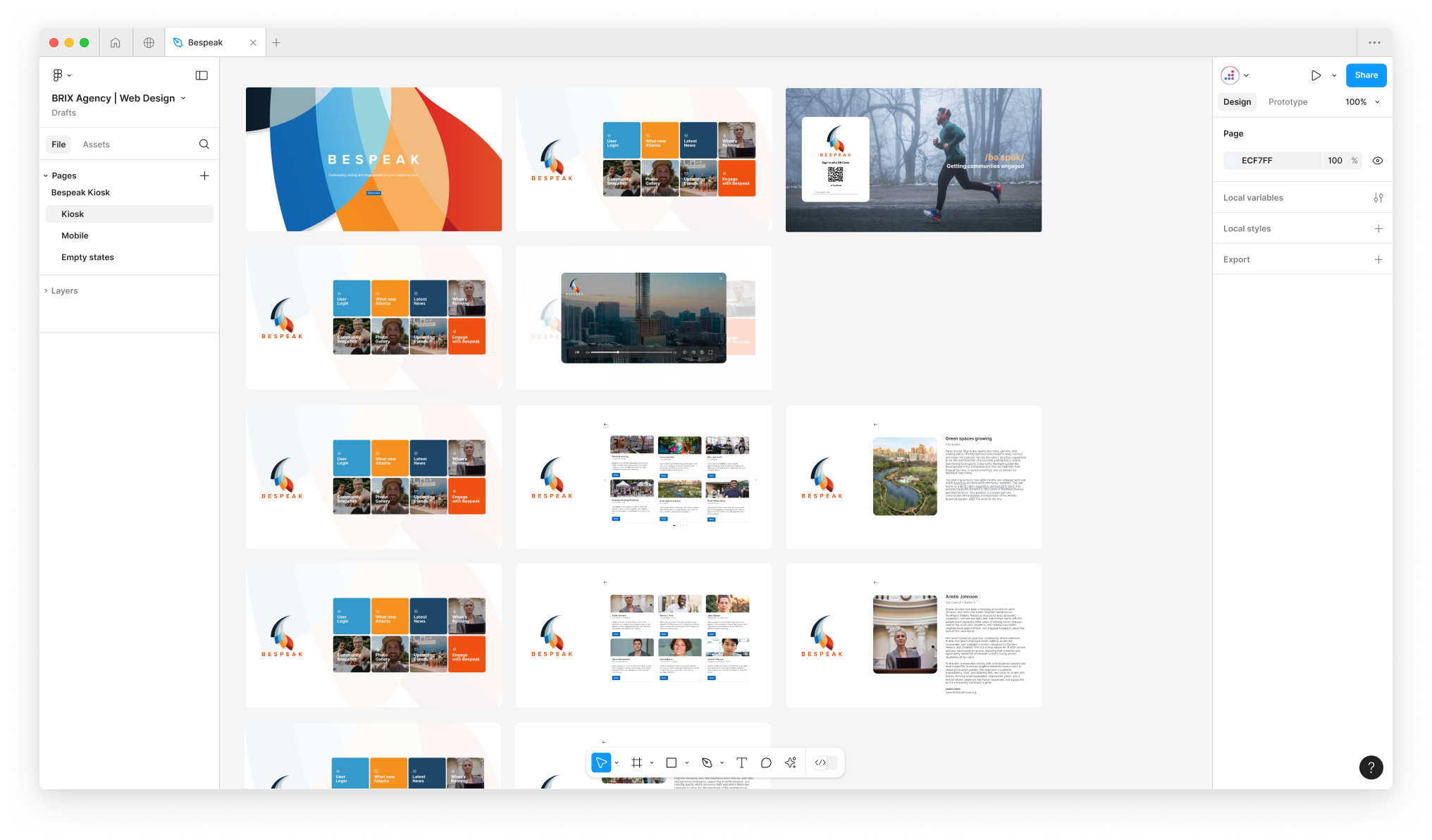
Bespeak is a community engagement platform built on transparency, accessibility, and collective intelligence.
-
Interactive Issue Boards
Residents co-create solutions in real time.
-
Community Profiles & Neighborhood Identity Spaces
Each area has its own digital “home” that reflects its culture and needs.
-
AI-Powered Summaries & Insights
Convert hundreds of comments into themes, tensions, and opportunities.
-
Decision Tracking
Clear visibility into what was proposed, what was selected, and why.
-
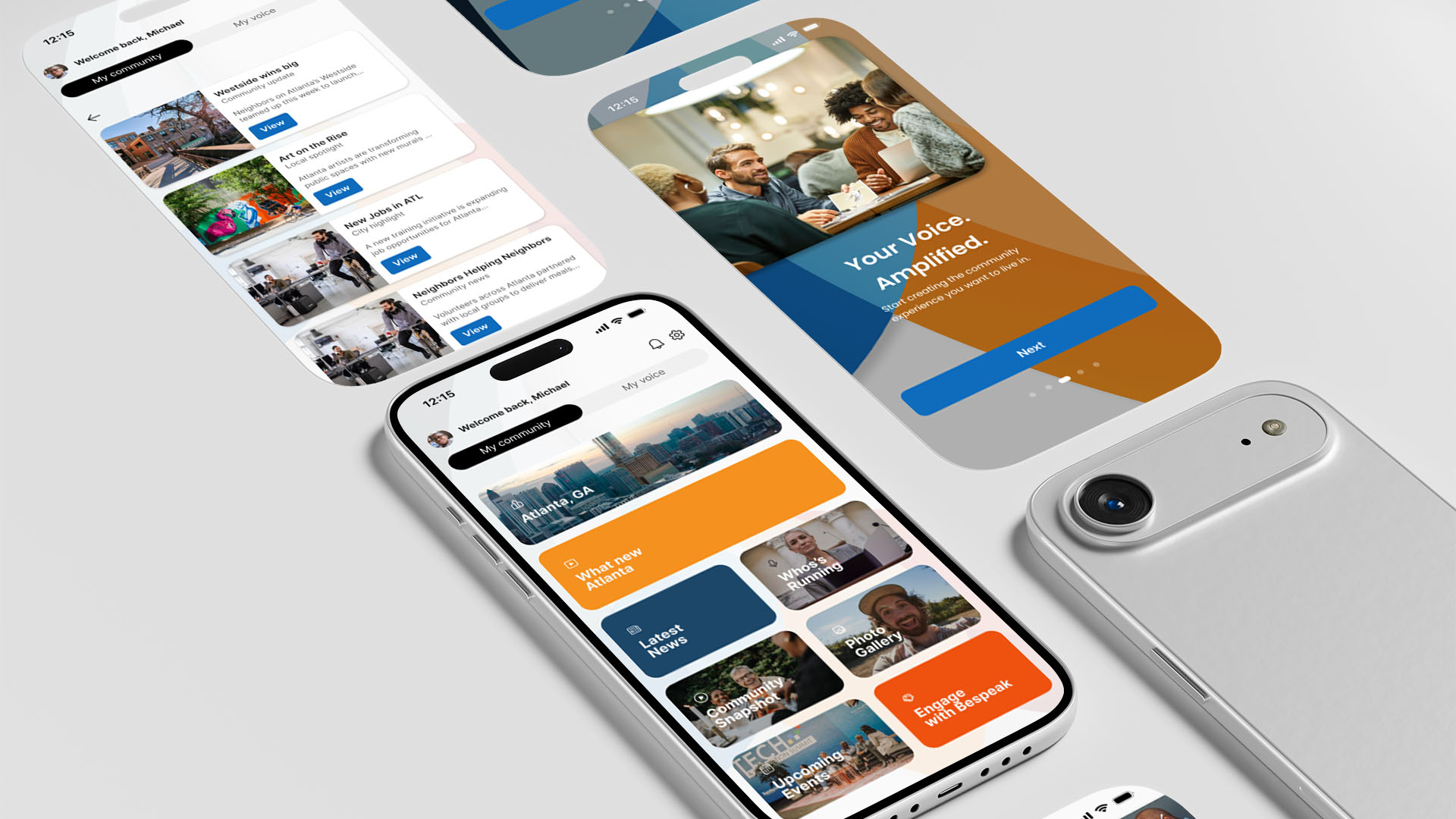
Mobile-first design
Built for accessibility and inclusive participation.
-
Scalable Design System
Works across multiple communities, cities, or development partners.
Bespeak shifts engagement from reactive (“fill out this survey”)
to collaborative (“let’s build this together”).
Designing with empathy for impact
Results
Pilot workshops in local communities proved the concept’s value. Community leaders reported increased trust, broader participation, and stronger collaboration with city planners.
Although still in growth stages, Bespeak has produced meaningful early wins:
-
40% faster resident feedback collection during early pilot sprints.
-
Higher engagement from groups traditionally left out of planning conversations.
-
Increased trust from community partners due to transparent decision-tracking.
-
A scalable platform that can support neighborhoods across Atlanta and beyond.
-
A strong foundation for fundraising, with clear system architecture and research-backed use cases.
-
Multiple partners expressing interest in implementation because it bridges the gap between civic design and community empowerment.
Most importantly, Bespeak reframes community planning as a shared responsibility, not a top-down process.